



Developing Problem-Solving Skills Through Modern Education
Education today is no longer just about memorizing facts or scoring high marks. It is about helping children think independently, analyze situations, and make informed decisions. Developing problem-solving skills has become one of the most important goals of modern education because these abilities prepare students for academic success, career growth, and everyday life.
At Ayana International School, we believe that every child has the potential to become a confident thinker and an innovative problem solver. Through experiential learning, interactive classrooms, and a focus on holistic education, we encourage students to explore ideas, ask questions, and develop practical solutions. This approach not only improves critical thinking skills but also nurtures creativity, collaboration, and lifelong learning.
Whether solving a challenging math problem, working on a science experiment, or collaborating on a group project, students who develop strong problem-solving abilities are better equipped to face the opportunities and challenges of the future.
Why Are Problem-Solving Skills Important for Students?
Problem-solving is more than finding the right answer. It is the ability to understand a situation, identify possible solutions, evaluate options, and make thoughtful decisions. These skills help students become independent learners who are confident in handling both academic and real-world challenges.
Modern employers value individuals who can think critically, communicate effectively, and adapt to changing situations. By focusing on skill development from an early age, schools prepare children for careers that may not even exist today.
Students with strong learning skills are more likely to:
- Think critically before making decisions.
- Adapt to new situations with confidence.
- Work effectively in teams.
- Solve real-life challenges creatively.
- Build resilience after setbacks.
- Develop leadership qualities.
- Improve academic performance.
These qualities contribute significantly to both personal and professional success.
Add Your Heading Text Here
Unlike traditional teaching methods that often rely on memorization, modern education encourages students to understand concepts deeply and apply their knowledge in practical situations. Students learn by participating in discussions, conducting experiments, asking questions, and solving real-world challenges. This process strengthens their ability to think logically and independently.
Some of the most effective teaching approaches include:
Experiential Learning
Experiential learning allows students to learn through direct experiences rather than simply reading textbooks. Activities such as science experiments, educational field trips, role-playing, and classroom projects encourage students to observe, analyze, and solve problems independently.
For example, instead of only learning about environmental conservation from a book, students may participate in tree plantation drives or recycling projects. These experiences make learning meaningful and memorable.
Inquiry-Based Learning
Curiosity is one of the strongest drivers of learning. Inquiry-based learning encourages students to ask questions and search for answers through research and exploration.
Instead of giving ready-made solutions, teachers guide students to investigate problems, gather information, and arrive at their own conclusions. This develops critical thinking skills and boosts confidence in decision-making.
Project-Based Learning
Project-based learning provides opportunities for students to work on meaningful assignments over an extended period. Whether designing a model city, creating a business plan, or conducting scientific research, students develop teamwork, communication, and analytical thinking.
Projects also improve creativity because students learn there can be multiple solutions to one problem.
Collaborative Learning
Many real-world problems require teamwork. Collaborative learning teaches students to share ideas, listen to different perspectives, and work together toward common goals.
Group discussions, presentations, and classroom activities help children improve communication while learning how to respect diverse opinions.
What Role Does Critical Thinking Play in Problem Solving?
Critical thinking skills are closely connected with problem-solving. Critical thinking enables students to evaluate information objectively before making decisions. Instead of accepting information at face value, students learn to ask questions such as:
- Is this information accurate?
- What evidence supports this idea?
- Are there alternative solutions?
- What could happen if I choose this option?
These habits encourage logical reasoning and independent thinking, making students better decision-makers throughout life.
How Does Holistic Education Support Skill Development?
Academic excellence alone is not enough to prepare students for the future. Holistic education focuses on the intellectual, emotional, physical, social, and creative development of every child. When students participate in sports, performing arts, leadership activities, coding clubs, debates, and community service, they encounter situations that require planning, decision-making, and teamwork.
This balanced approach develops:
- Emotional intelligence
- Communication skills
- Leadership abilities
- Time management
- Creativity
- Adaptability
- Confidence
These life skills complement academic knowledge and prepare students for lifelong success.
How Technology Enhances Student Learning
Technology has transformed the way students learn. Interactive classrooms, digital resources, educational apps, and virtual simulations provide engaging learning experiences that encourage exploration.
Students can:
- Solve interactive quizzes.
- Participate in virtual science labs.
- Learn coding through hands-on projects.
- Collaborate online with classmates.
- Access global educational resources.
Technology also supports personalized student learning, allowing children to progress at their own pace while receiving immediate feedback. However, technology works best when combined with excellent teaching practices and meaningful classroom experiences.
Why Experiential Learning Makes a Lasting Difference
Children remember experiences better than lectures. This is why experiential learning has become an essential part of quality education.
Instead of simply memorizing information, students:
- Observe.
- Experiment.
- Reflect.
- Apply concepts.
- Improve through feedback.
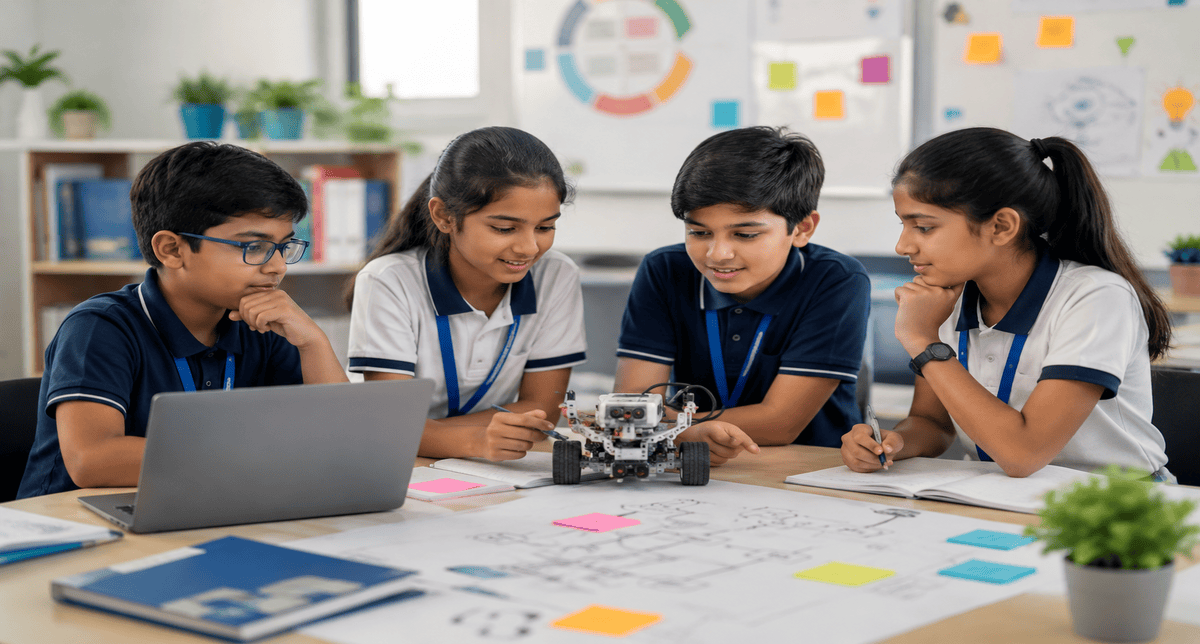
For example, building a working robot teaches mathematics, engineering, teamwork, creativity, and problem-solving simultaneously. Such experiences encourage deeper understanding and long-term knowledge retention.
How Can Parents Help Develop Problem-Solving Skills at Home?
Schools play a major role, but parents can also strengthen problem-solving abilities through everyday activities.
Simple practices include:
- Encouraging children to ask questions.
- Allowing them to make age-appropriate decisions.
- Playing puzzles and strategy games.
- Reading together and discussing stories.
- Encouraging creativity through art and building activities.
- Teaching children to learn from mistakes instead of fearing failure.
When children receive consistent encouragement both at school and home, they become confident and independent learners.
Why International Schools Focus on Future-Ready Learning
Leading international schools understand that the future demands more than academic knowledge. Students need adaptability, innovation, communication, collaboration, and leadership.
Modern classrooms encourage:
- Independent thinking
- Creative problem-solving
- Teamwork
- Global awareness
- Practical application of knowledge
- Lifelong learning
This educational philosophy prepares students to succeed in higher education, competitive careers, and an ever-changing world.
Why Choose Ayana International School?
At Ayana International School, learning goes beyond textbooks. Our student-centered approach combines academic excellence with experiential learning, holistic education, and continuous skill development.
We create an environment where students are encouraged to ask questions, think critically, collaborate with peers, and confidently solve challenges. Through innovative teaching practices, experienced educators, and engaging classroom experiences, every child develops the knowledge and confidence needed to thrive in today’s dynamic world.
By nurturing curiosity, creativity, and resilience, Ayana International School prepares students not just for examinations but for life.
Conclusion
The future belongs to individuals who can think independently, adapt quickly, and solve problems with confidence. Developing problem-solving skills through modern education empowers students to become creative thinkers, responsible citizens, and future leaders. By combining critical thinking skills, experiential learning, holistic education, and continuous skill development, schools can create meaningful learning experiences that prepare children for success beyond the classroom.
At Ayana International School, we are committed to nurturing confident learners through innovative teaching methods and a supportive learning environment. Our focus on quality education, student-centered learning, and future-ready skills helps every child grow academically, socially, and emotionally, laying the foundation for lifelong success.
Frequently Asked Questions
1. What are problem-solving skills in education?
Problem-solving skills refer to a student’s ability to identify challenges, analyze situations, think critically, and develop practical solutions. These skills help children become independent learners and confident decision-makers.
2. Why are critical thinking skills important for students?
Critical thinking skills help students evaluate information, make informed decisions, solve complex problems, and develop logical reasoning, which are essential for academic and career success.
3. How does experiential learning improve student learning?
Experiential learning allows students to learn through practical experiences such as projects, experiments, and field visits. It improves understanding, creativity, confidence, and long-term knowledge retention.
4. What is holistic education?
Holistic education focuses on developing a child’s academic, emotional, social, physical, and creative abilities to prepare them for lifelong success.
5. How do international schools encourage problem-solving?
International schools use project-based learning, collaborative activities, inquiry-based teaching, technology integration, and experiential learning to develop problem-solving skills and prepare students for global opportunities.
6. How can parents improve their child's problem-solving skills?
Parents can encourage independent thinking by asking open-ended questions, allowing children to solve everyday challenges, playing educational games, and supporting curiosity through reading and exploration.